Post Hurricane Duct Inspection: SW Florida Checklist
Post Hurricane Duct Inspection: A SW Florida Homeowner's Checklist
A post hurricane duct inspection is the step most Naples and Fort Myers homeowners skip and then regret three weeks later when the AC starts smelling musty or a respiratory symptom returns. Atlantic hurricane season runs June 1 through November 30 every year, and even storms that cause no visible roof damage can drive moisture, debris, and microbial spores into a home's duct system. (FEMA's Ready.gov hurricane preparedness guidance is a good companion to the duct-specific steps below.) The window to catch hidden damage runs roughly 14 days from the date of the storm. After that, mold colonies become harder to remediate and insurance documentation gets messier.
This guide gives you three checklists (pre-storm, same-day, week-1) and a clear set of triggers for when to bring in an experienced duct professional. Print it out before hurricane season starts and keep it with your hurricane prep folder.
| Time window | Goal | Action level |
|---|---|---|
| Before landfall | Protect the system | Homeowner |
| First 24 hours after | Document and assess visible damage | Homeowner |
| Day 2 through Day 14 | Hunt hidden damage | Homeowner + pro inspection |
| Beyond Day 14 | Remediate or accept escalating cost | Pro required |
Why a Post Hurricane Duct Inspection Matters in SW Florida
Hurricanes don't have to flood a home to damage the duct system. The four most common ways a storm affects ducts in SW Florida are:
- Water intrusion through roof, soffit, or attic vents while the home is still sealed
- Outdoor unit debris that pushes inside through suction
- Rodent or insect entry through damaged vent caps and exterior penetrations
- Wet attic insulation around supply ducts after partial roof exposure or driven-rain events
NOAA's National Hurricane Center has tracked SW Florida as one of the most active landfall corridors in the United States over the past decade. Naples, Fort Myers, Cape Coral, Bonita Springs, Estero, Marco Island, Sanibel, and Lehigh Acres have all seen direct or near-miss impacts in recent seasons. In every one of those events, homes that look untouched on the outside often have moisture damage in the attic or air handler closet.
The reason this is a duct issue specifically: when humid air gets into the attic during a storm and the AC is off (because power is out), there is no dehumidification happening. Insulation around supply trunks gets damp. Dust on duct interiors becomes a substrate for microbial growth. By the time the homeowner restarts the AC, the system pushes that air through every room, which is exactly the kind of indoor air quality problem the EPA warns about. We cover this in more depth in our air duct cleaning guide for Naples homes, and a storm is one of the triggers that can override your normal air duct cleaning frequency.
Pre-Storm Checklist: Protect the Duct System Before Landfall
Run this list 48 to 72 hours before projected landfall. Most items take under 10 minutes each.
- Replace the air filter. A fresh filter ensures the system runs efficiently after restart and doesn't push contaminated air across a partially blocked filter.
- Photograph the air handler and attic. Walk into the air handler closet and the attic with a phone camera. Take wide and close shots of the equipment, ducts, insulation, and any visible water damage that already exists. This protects you for any later insurance claim by establishing a baseline.
- Inspect exterior vent hoods. Walk around the outside of the home. Confirm the dryer vent hood, kitchen exhaust hood, and bathroom exhaust hoods are securely attached. Tighten any loose screws.
- Cover the outdoor condenser unit only after powering it off at the breaker. If you choose to cover the outdoor unit, kill power first. Never cover an operating condenser. Many SW Florida homes do not need to cover the unit at all if it is rated for outdoor weather, which most are.
- Pre-treat the condensate drain line. Pour a half cup of distilled white vinegar through the access fitting near the air handler. A clear drain line means the system will restart without standing water in the pan.
- Set the thermostat correctly. If you are evacuating, leave the system set to about 78F. If you are staying and losing power, switch the system off at the thermostat to prevent compressor damage if power flickers.
- Stage hurricane straps or a tarp for the outdoor unit. Not for routine winds, but in case of post-storm damage to the surrounding structure that could expose the unit to elements.
- Save the contact info for an experienced duct service company. Inspections and remediation services book up fast after a storm. Have a number ready before you need it.
Reserve a priority post-storm duct inspection in Naples, FL.
ClearAir Solutions - Family-Owned & Locally Operated
(855) 593-5923Same-Day Checklist: First 24 Hours After the Storm Passes
Run this list once it is safe to re-enter the home. Power may not be back yet. Do not run any electrical equipment until you complete the visual safety items.
- Do not power on the AC if you smell anything burning, see standing water near the air handler, or notice damaged wiring around the outdoor unit. Burning smells, water at the air handler, or compromised wiring are immediate stops.
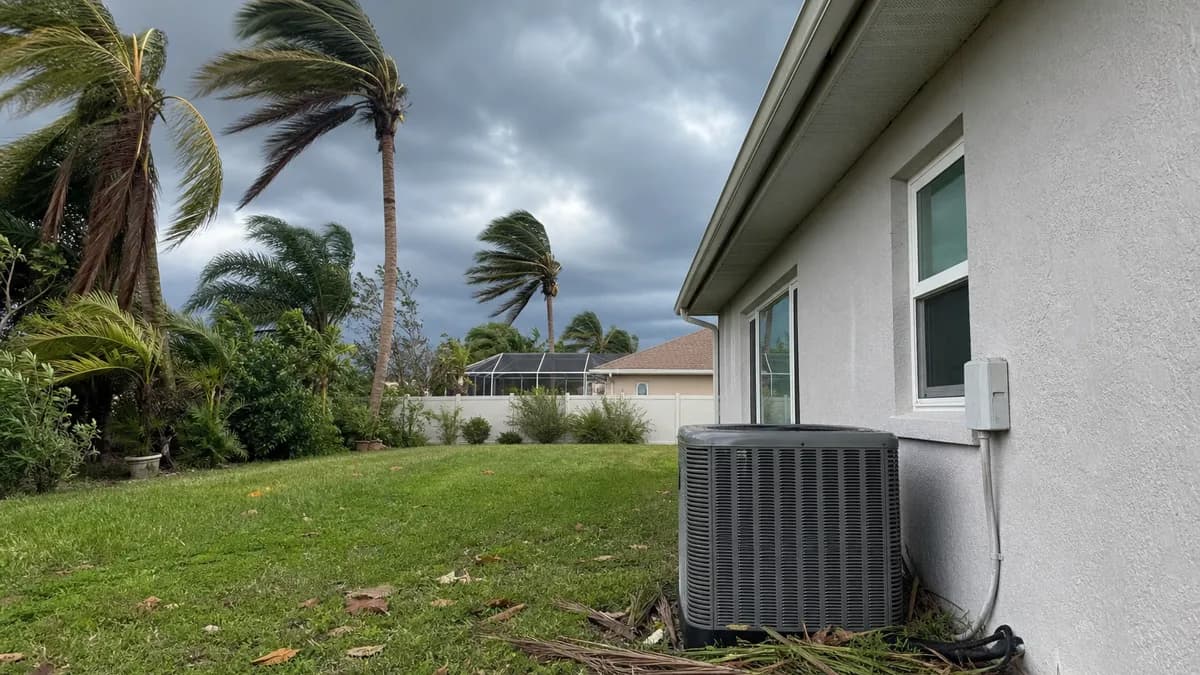
- Inspect the outdoor unit for debris, flooding, or impact damage. Walk around the outdoor unit. Look for fallen branches resting on it, water lines on the case (a sign it was partially submerged), bent fins, or impact dents. Photograph anything you find.
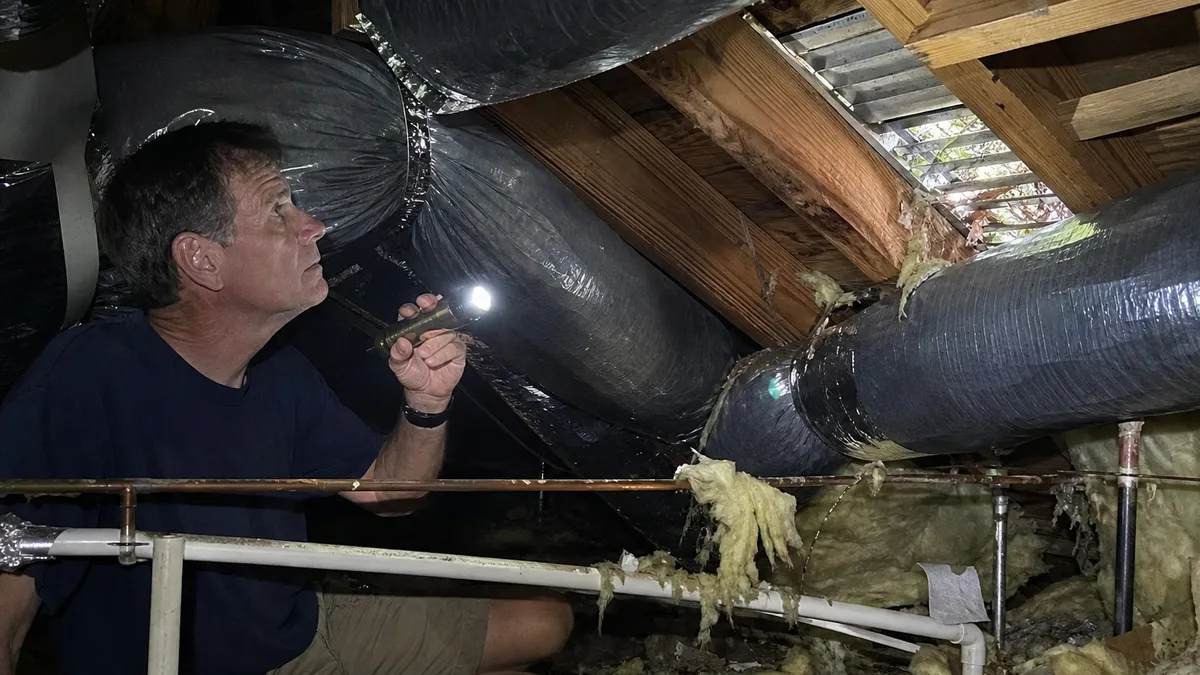
- Check the attic for water intrusion. Use a flashlight. Look at the underside of the roof deck, the insulation around supply ducts, and the area above the air handler closet. Any water staining is a sign of intrusion.
- Inspect every supply register from below. Stand under each register and look up. Drip marks on the ceiling around the register, water staining on the diffuser, or sagging are all flags.
- Look for blown-off vent caps and exterior hoods. Walk around the exterior. The dryer vent hood, bathroom exhaust hoods, kitchen exhaust hood, and any roof penetrations should all still be in place.
- Listen for unusual sounds during a fan-only test (only if power is stable). With the system set to fan-only and cool off, run for 10 minutes. Listen for rattling, whistling, or scraping. Any new noise is worth investigating.
- Smell-test the supply air during the fan-only run. A musty, earthy, or mildew smell at any register is the earliest indicator of microbial contamination starting to form.
- Document everything with photos and notes. Date and time stamp every photo. Save them in a single folder labeled with the storm name. Insurance claims are easier when documentation is organized.
- Do not run the AC in cooling mode if there is any standing water at the air handler. Cut power at the breaker and call for service.
If you smell anything burning, see arcing or sparking, or find any standing water touching electrical components, leave the breaker off and contact a licensed pro before doing anything else.
Week 1 Duct Inspection Checklist: Hidden Damage Hunting
The hidden damage from a hurricane usually shows up between Day 2 and Day 14. By Day 21, microbial growth that started during the wet period is usually established and visible. Run through this list at least twice during week 1.
- Walk every register in the home and smell-test. A musty smell at one specific register usually means the duct serving that room has wet insulation or biofilm starting. Note which registers are affected.
- Inspect the insulation around exposed supply trunks in the attic. Use gloves. Press lightly on the insulation. If it is damp, it stays compressed; if it is dry, it springs back. Damp insulation around a duct needs to be removed and replaced, not dried in place.
- Look at duct boots from below. A duct boot is the connection between the duct and the register box. Sagging, cracking, or daylight visible around the boot means the seal is broken and conditioned air is mixing with attic air.
- Check the air handler closet floor twice in the first week. Floor stains can show up days after the actual leak when slow seepage finally reaches a visible surface.
- Re-inspect every exterior vent hood for debris. Wind-driven leaves and palm fronds can lodge in dryer vent hoods, kitchen exhaust hoods, or fresh-air intake screens. Clear any debris.
- Watch for new respiratory symptoms in the home. Family members reporting nighttime cough, throat irritation, or worsening allergies that did not exist before the storm is a strong signal of indoor air quality change.
- Run the AC continuously for at least 48 hours before declaring the system fine. Microbial growth that was triggered by storm humidity usually starts producing odor within the first 24 to 48 hours of restored cooling. A short run does not prove the system is clean.
- Look for pest entry signs. Storms displace rodents and insects, which look for dry shelter. Check for fresh droppings or nesting material near the air handler, in attic insulation, and around exterior vent hoods.
- Inspect any visible duct interior with a flashlight at the registers. Remove a register cover from a return duct (turn the system off first). Shine a flashlight inside. Note any visible water staining, debris, or microbial growth.
- Review and update your storm photo folder. Add any new findings with date stamps so the documentation chain stays intact for insurance.
When to Call an Experienced Duct Pro After a Hurricane
Some findings cannot be addressed by a homeowner regardless of how thorough the visual inspection is. Call a professional inspection within 48 hours when any of the following are true.
Immediate triggers (call same-day if possible):
- Standing water in the air handler closet
- Visible water stains on the ceiling around any supply register
- A musty smell that arrives within minutes of restoring AC and gets worse over a few days
- Damaged or partially submerged outdoor condenser unit
- Power was off for more than 48 hours during humid weather and the home was sealed
- Attic flooding or visible roof intrusion above the duct system
- New respiratory symptoms in any household member after the storm
Important triggers (call within the week):
- Lingering damp smell in any room more than 5 days after the storm
- Insulation around duct trunks that stayed damp despite restored AC
- Visible debris around vent hoods that cannot be cleared from the ground
- Repeated tripping of the AC's float switch (signals condensate backup)
- Insurance adjuster has asked for a professional duct assessment
Naples, Fort Myers, Cape Coral, Bonita Springs, Estero, Marco Island, Sanibel, and Lehigh Acres all see service backlogs build within days of any major storm. Calling early is the difference between a same-week appointment and a three-week wait.
What a Post Hurricane Duct Inspection by a Pro Includes
A real post-storm inspection goes well beyond a visual walkthrough. An experienced duct technician treats it as a forensic exercise, looking for hidden moisture, microbial colonization, and structural duct damage that a homeowner cannot see.
The standard process:
1. Visual and camera inspection of all accessible ductwork. The technician opens the air handler, examines the coil and drain pan, looks at the plenum, and uses a small inspection camera to check the interior of supply and return trunks. Any visible water staining, biofilm, or debris is photographed.
2. Moisture meter readings on duct insulation. A pin-style moisture meter is the only reliable way to confirm whether duct insulation is dry. Visual inspection alone misses concealed dampness inside fiberglass batts and inside closed-cell duct insulation.
3. Coil, blower wheel, and condensate inspection. The most common post-storm issues live at the air handler. Standing water in the drain pan, a slowly clogging condensate line, and dust accumulation on a blower wheel that ran during a high-humidity period all point to immediate cleaning needs.
4. Air handler closet inspection. The closet itself often shows storm damage that was missed in the rest of the home. Drywall water stains, baseboard separation, and floor moisture readings document any leak path that ran through the closet.
5. Referral to a licensed mold specialist if microbial growth is confirmed. If the inspection confirms mold or significant microbial growth, the right next step is a licensed mold remediation specialist. We will flag what we find, document it for your records, and recommend a qualified specialist rather than treating confirmed mold ourselves.
6. Air sample if recommended. For homes with strong respiratory symptoms or visible microbial growth, an air sample sent to a third-party lab confirms what is in the air. The decision to sample is made jointly with the homeowner based on findings.
7. Written report with photos. Every inspection ends with a written report listing findings, recommended actions, and photos of every area inspected. This is what an insurance claim or a doctor's documentation request needs.
| Inspection type | Visual-only walkthrough | Full source-removal inspection |
|---|---|---|
| Time on site | 30 to 45 minutes | 90 to 150 minutes |
| Moisture readings | No | Yes, multiple points |
| Camera inspection of ducts | No | Yes |
| Coil and drain pan inspected | Sometimes | Always |
| Microbial growth documented for referral | No | Yes |
| Written report with photos | No | Yes |
| Insurance documentation quality | Low | High |
Insurance and Documentation: What to Capture for Your Claim
Florida homeowner insurance commonly covers windstorm damage to ductwork, but mold coverage varies by carrier and policy. Some policies require a separate mold rider. Some cap mold coverage at a specific dollar amount per event. Read your declarations page before you assume coverage exists.
What to capture and keep, regardless of carrier:
- Date-stamped photos of every duct, register, and the air handler before the storm if possible
- Date-stamped photos of every duct, register, and the air handler after the storm
- The written professional inspection report
- Receipts for any cleaning, antimicrobial treatment, or duct replacement work
- Notes on dates and times when the AC was off due to power loss
- Symptoms log if any household member experienced new respiratory issues
The Florida Department of Financial Services has consumer guidance on post-hurricane insurance claims, and Citizens Property Insurance (the state-backed carrier covering many SW Florida homes) publishes claim documentation requirements. Keep your documentation in a single folder. Most claim disputes come down to documentation, not coverage.
A professional inspection report carries weight with adjusters because it identifies specific damage to a specific component, with photos and moisture readings. A homeowner-only report rarely meets the same bar.
Frequently Asked Questions About Post Hurricane Duct Inspection
Do I need a post hurricane duct inspection if my home didn't flood?
Yes if the power was off for more than 24 to 48 hours during humid weather. Yes if there was any attic intrusion, even small. Yes if debris hit the outdoor unit or any exterior vent hood. Yes if any household member with allergies or asthma is reporting new symptoms. Many of the worst post-storm duct issues we find are in homes that looked completely fine on the outside but were sealed without AC during the worst of the humidity.
How soon after a hurricane should I have my ducts inspected?
Run the homeowner visual checklist within 24 hours of safe re-entry. Schedule a professional inspection within the first 1 to 2 weeks if any of the trigger conditions apply, especially any musty smell, any standing water near the air handler, or any visible water staining at supply registers. Microbial growth that started during a wet period typically becomes visible by Day 14, and remediation gets harder the longer it sits.
Will my homeowners insurance cover post hurricane duct cleaning in Florida?
Often yes for windstorm or hurricane damage to the ductwork itself. Coverage for resulting mold remediation varies by carrier and policy. Some standard policies exclude or cap mold coverage and require a separate rider. Document everything (photos, professional reports, receipts) and file the claim early. The Florida Department of Financial Services has consumer guidance for hurricane claims, and your declarations page is the definitive source for what your specific policy covers.
What does mold in air ducts after a flood look or smell like?
The first sign is almost always smell, not appearance. A musty, earthy, or basement-like odor at one or more registers is the earliest indicator. Visual mold appears as black, green, gray, or white patches on duct insulation, on the inside of plenums, or around duct boots where they connect to register boxes, the same mold and moisture growth the CDC ties to damp indoor environments. By the time it is visible, it has usually been growing for 7 to 14 days. Catching it at the smell stage is meaningfully easier and cheaper to remediate than waiting until it shows up.
Can I run my AC right after a hurricane?
Only after a visual inspection of the outdoor unit confirms no debris contact, no flood line on the case, and no exposed or damaged wiring. Only after power has stabilized for at least 30 minutes (frequent flickers can damage the compressor). Run the system on fan-only first for 10 to 15 minutes and listen for new sounds, then switch to cooling. If anything seems wrong, stop and call a pro before continuing.
How much does a post hurricane duct inspection cost in Naples, FL?
Inspection-only pricing typically runs $150 to $300 for a single-system home. That includes the visual walkthrough, camera inspection, moisture readings, coil and drain pan inspection, and a written report with photos. Full cleaning, antimicrobial treatment, or any duct replacement is priced separately based on findings. Most insurance carriers reimburse the inspection cost when it is part of a documented hurricane claim.
Schedule a Post Hurricane Duct Inspection in Naples, FL
Atlantic hurricane season runs June 1 through November 30, and the inspection window for hidden duct damage runs about 14 days from any storm. Don't wait for visible mold or for symptoms to worsen. Catching it early is cheaper, faster, and better-documented for any insurance claim.
ClearAir Solutions provides post-hurricane duct inspections and cleaning across Naples, Fort Myers, Cape Coral, Bonita Springs, Estero, Marco Island, Sanibel, and Lehigh Acres. We arrive with moisture meters, inspection cameras, and the documentation tools your insurance adjuster will ask for. If we confirm mold, we will document it and refer you to a licensed mold remediation specialist.
Call (855) 593-5923 to schedule a post-hurricane duct inspection. Family-owned and locally operated, serving SW Florida. Priority appointments are reserved for storm-affected homes during active season.
Need help in Naples, Fort Myers, or anywhere in Southwest Florida? Call ClearAir Solutions at (239) 306-2327.