
Musty Smell From AC Vents: Causes, Fixes & When to Call
Musty Smell From AC Vents: Causes, Fixes, and When to Call a Pro
A musty smell from AC vents almost always comes from the same root cause: moisture sitting on organic material somewhere in the system, usually the evaporator coil, the drain pan, or the inside of the ductwork. In a Naples, Fort Myers, or Cape Coral home running the AC nine months out of the year, that combination is common. Below is a Q&A walkthrough of the four causes we see most often, the DIY fixes that work, the limits of those fixes, and the point at which a professional needs to step in.
A quick reference of what causes a musty smell from AC vents and what fixes it:
| Likely cause | Where it lives | Best fix |
|---|---|---|
| Microbial growth on coil | Evaporator coil surface | Professional coil cleaning |
| Standing water in drain pan | Beneath the air handler | Clear and flush the condensate line |
| Biofilm in ductwork | Inside supply or return ducts | Full duct cleaning |
| Wet duct insulation | Around the supply trunk in the attic | Inspection, dry, replace insulation |
What Causes a Musty Smell From AC Vents in Florida Homes?
Four causes account for the vast majority of musty AC smells we field calls about across Naples, Fort Myers, Bonita Springs, and Cape Coral.
Microbial growth on the evaporator coil. The coil is cold and constantly wet during operation. Dust pulled through the filter sticks to the wet surface, and given enough time, biofilm forms. Once the biofilm is in place, every cycle of warm humid Florida air across that surface refreshes the smell.
Standing water in the drain pan. The condensate drain pan should empty as fast as the coil produces water. When the line clogs or slopes wrong, water sits in the pan, ferments organic matter, and pushes that odor up through the supply ductwork.
Biofilm inside the ductwork or plenum. Years of dust plus periodic moisture, especially in older flexible ducts in the attic, leads to a slimy film on the duct interior. It does not need to be visible mold to smell musty.
Wet insulation. This is more common after a leak event (roof leak, attic AC line leak, or post-storm intrusion). Insulation around supply trunks gets wet, holds moisture, and the air running over it carries the smell into the rooms.
In our experience servicing SW Florida homes, the first two causes account for roughly 70% of musty smell calls. The duct and insulation causes show up more often after a specific event (a renovation, a leak, a hurricane).
Is the Musty Smell From My AC Vents Mold or Mildew?
Practically speaking, the distinction does not change what you do about it. Both are forms of microbial growth that thrive in moist environments, and as CDC guidance on mold and moisture explains, controlling indoor moisture is the key to controlling either one. Mildew typically refers to a flatter surface growth often caused by fungi from the same family as molds, and mold refers to thicker, often colored colonies. Without a lab test on a swab, you cannot be certain which one is producing the smell.
What matters for the fix:
- The moisture source has to be addressed
- The contaminated surface has to be physically cleaned (not just sprayed)
- An EPA-registered antimicrobial finishes the job
A lab test only matters if a doctor has asked for species identification due to a specific health condition. For day-to-day cleaning decisions, treat the smell as one problem with one set of fixes.
There is also a phenomenon technicians call "dirty sock syndrome." It is caused by specific microbes that produce a sour, locker-room odor on cold coils. The fix is the same: deep clean the coil, sanitize, and prevent moisture from sitting on it again.
Get rid of that musty AC smell in your Naples home today.
ClearAir Solutions - Family-Owned & Locally Operated
(855) 593-5923Why Does the Musty Smell Get Worse When the AC First Turns On?
Two reasons. First, while the AC is off, moisture remains on the coil and inside the ductwork without airflow to push odors anywhere. They concentrate. When the system fires up, the first 30 to 60 seconds of airflow rushes that concentrated smell out through every supply register at once.
Second, in Florida humidity, the coil pulls a large amount of water vapor out of the air the moment it gets cold. That sudden burst of moisture, combined with whatever organic film is on the coil, creates a strong aroma right when you most notice it.
The pattern we see across Naples, Fort Myers, and Cape Coral homes:
- Strongest in the morning after a long off-cycle
- Strong after a long power outage in summer
- Strong after returning from vacation with the thermostat set high
- Mildest during a continuous run on a stable temperature day
If the smell only appears for the first minute and then fades, the source is almost always the coil or the immediate plenum. If the smell continues through the cycle, the duct interior is likely involved as well.
Can a Musty Smell From AC Vents Make You Sick?
EPA guidance on indoor air quality is balanced on this. Not all microbial exposure causes symptoms in everyone. People with allergies, asthma, weakened immune systems, or chronic respiratory conditions are more likely to react to indoor microbial growth. Common reactions include a stuffy nose, throat irritation, watery eyes, wheezing, and headache.
What we tell SW Florida homeowners:
- If symptoms only happen indoors, especially when the AC is running, the indoor air is a variable worth investigating
- If a child or family member with asthma has had more flare-ups recently and the AC has started smelling musty, treat it as a priority
- A doctor is the right person to evaluate symptoms, not an HVAC technician
Our role is the source, not the diagnosis. If you eliminate the source and symptoms persist, that's a medical question.
What Quick Fixes Can I Try Before Calling a Professional?
For mild musty smells, especially smells that have only started in the last week, several DIY fixes work. Each takes 5 to 30 minutes and uses tools most homeowners already have.
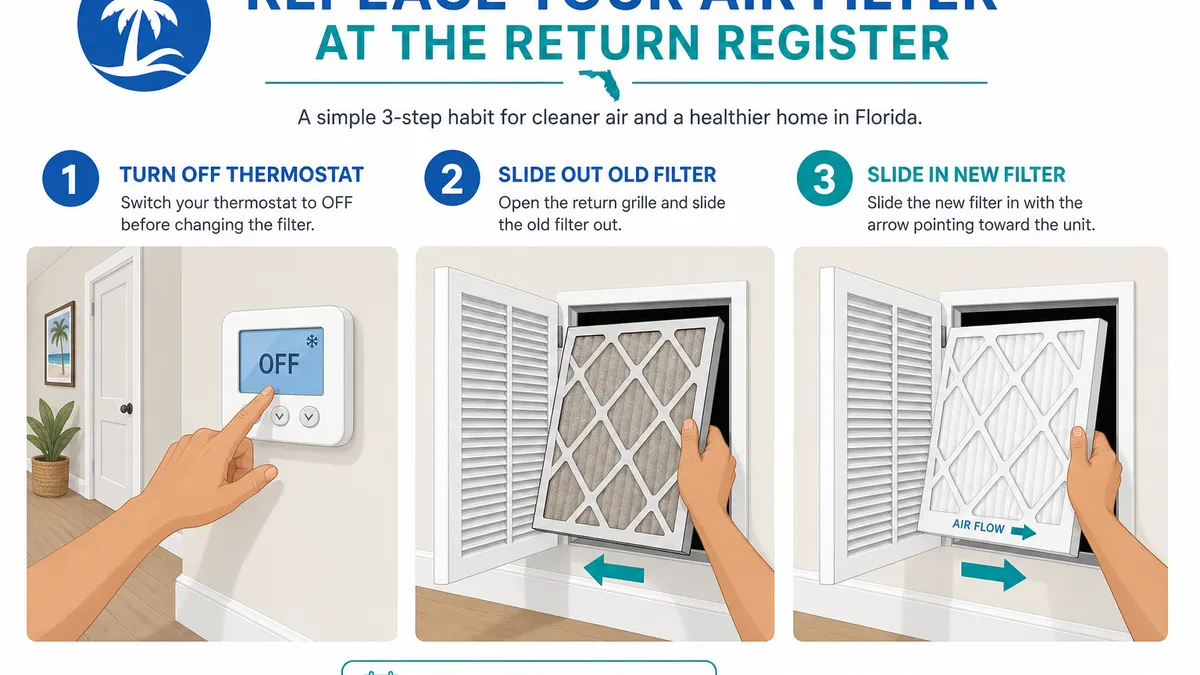
Step 1: Replace the air filter. A loaded filter restricts airflow, which lets moisture sit longer on the coil. In Florida, change pleated 1-inch filters every 30 to 60 days. Higher-MERV media filters can run 90 days. Use the date the manufacturer prints on the frame as a starting point and adjust based on dust load.
Step 2: Clear the condensate drain line. Locate the PVC drain line near the air handler. There is usually a T-shaped access fitting with a cap. Pour a half cup of distilled white vinegar through the cap, replace the cap, and let it sit for 30 minutes. Then run a wet/dry vacuum at the outdoor termination of the line for one to two minutes to pull any clog through.
Step 3: Run the system on fan-only for 30 to 60 minutes. On the thermostat, switch the fan from AUTO to ON, and switch the system from COOL to OFF. The fan will dry the coil and ducts. This is a useful interim step if a family member has allergies and you are waiting for service.
Step 4: Treat the drain line preventively. Once a month during cooling season, pour a half cup of vinegar through the access fitting to keep the line clear. Avoid bleach, which can damage some PVC joints and cause irritation if it backs up.
Step 5: Inspect for visible dampness. Look at the floor under the air handler. Look at the insulation around the supply trunk where you can see it. If you find water, mark its location, photograph it, and call a pro. Hidden leaks rarely fix themselves and can cause more damage over time.
Safety warnings:
- Always cut power at the breaker before opening the air handler
- Never spray bleach into the ductwork
- Do not run the AC if you find standing water at the air handler
When Do DIY Fixes Stop Working for a Musty AC Smell?
DIY fixes work for early-stage problems where the moisture is recent and the biofilm is thin. They reach a limit fairly quickly when the smell is established.
You need a pro when:
- The smell returns within 24 to 48 hours of every DIY fix
- You can see visible mold around any vent or on the air handler
- The smell persists after a coil cleaning attempt (the duct interior is likely involved)
- Family members with asthma or allergies are still reacting
- The drain line keeps clogging despite repeated vinegar treatment
- There is any standing water in the air handler closet
The fastest way to know whether you've crossed the line: try the four DIY steps above on a single weekend. If the smell is back by the next weekend, the source is past what surface fixes can reach.
How Does a Professional Eliminate the Musty Smell From AC Vents?
An experienced technician treats the musty smell as a system problem rather than a single component. The standard process has six parts.
1. Inspection and source identification. Before any cleaning, the technician removes the air handler access panels, inspects the coil with a flashlight and camera, checks the drain pan, looks at the blower wheel, and examines the duct interior at the plenum and at several registers. We document with photos.
2. Coil deep clean. A foaming, no-rinse coil cleaner, or in heavier cases a steam clean, removes the biofilm. The technician confirms the coil drains cleanly and that fins are not bent or blocking airflow.
3. Blower wheel cleaning. Years of dust on the blower wheel reduces airflow and traps odor. The wheel is removed when needed and cleaned, or cleaned in place with proper containment.
4. Condensate flush. The drain pan is cleaned and the condensate line is fully flushed. We add a tablet or pan treatment that prevents biofilm from forming for 30 to 60 days.
5. Whole-system duct cleaning. Negative-pressure containment, mechanical agitation, and source removal across all returns and supplies. This is what physically removes the biofilm and dust from inside the duct system instead of just disturbing it.
6. EPA-registered antimicrobial sanitization. After cleaning, an EPA-registered antimicrobial product is fogged through the system per the label. This is the finishing step, not a substitute for cleaning.
A typical full musty-smell elimination job takes 4 to 6 hours on a single-system Naples home and the smell is usually gone by the time we leave. If we cannot eliminate it on the first visit, we tell the homeowner what is left to investigate (often wet insulation behind a wall or roof leak above an attic supply trunk).
How Can I Prevent the Musty Smell From Coming Back?
The cooling load and humidity in SW Florida mean prevention has to be active. The homes that stay smell-free are the ones that follow a short maintenance routine.
Monthly:
- Replace 1-inch pleated filters every 30 to 60 days
- Visually check around the air handler for moisture
- Pour vinegar through the condensate drain access
Twice a year:
- Schedule a coil and drain inspection (spring and fall)
- Inspect the supply registers and clean the slats
Annually:
- Have a technician check static pressure and airflow
- Inspect duct insulation for moisture
- Verify indoor humidity is in the 45-55% range
Indoor humidity matters more than most homeowners realize. Above 60% relative humidity indoors, microbial growth on cool surfaces accelerates. A whole-house dehumidifier or a dehumidifying setting on the thermostat helps in homes that struggle to stay below 55% during the rainy season.
Some homeowners ask about UV-C lights inside the air handler. The evidence on UV-C effectiveness for ongoing AC odor control is mixed. We install them in cases where a coil tends to re-colonize quickly, but they are not a substitute for cleaning. They are a maintenance aid.
Frequently Asked Questions About Musty AC Smells
How long does it take for a musty smell from AC vents to go away?
If the cause is a clogged drain or a dirty filter, the smell usually dissipates within a few hours of the fix. If biofilm is on the coil and inside the ducts, you need a professional cleaning, and the smell is usually gone by the end of the same visit. If the smell lingers more than 24 hours after a thorough professional cleaning, there is likely a hidden moisture source (wet insulation, a roof leak, a leaking supply boot) that needs separate attention.
Will an air freshener get rid of the musty AC smell?
No. Air fresheners only mask the smell while doing nothing about the moisture or microbial growth that produces it. Some fragrances also irritate allergy sufferers and can make breathing worse for asthmatic family members. Treat the source, not the smell. Once the source is gone, the freshener becomes unnecessary.
Does a musty AC smell mean my coil is moldy?
Not necessarily. The smell can come from biofilm (a layer of bacteria and fungi mixed with dust), from mildew on the drain pan, from organic dust on the blower wheel, or from wet duct insulation. A visual coil inspection through the air handler access panel settles the question quickly. In many cases the coil is the source even when there is no visible mold, because biofilm can produce strong odors without dramatic visible growth.
Can I run my AC if it smells musty?
For a mild, short-term smell with no other symptoms, running the AC is usually fine while you work through the DIY fixes. If a family member has asthma, severe allergies, or a respiratory condition, switch the system to fan-only or off until a professional addresses it. Running a heavily contaminated system also continues to deposit material into your ductwork, which makes the eventual cleaning more involved.
How much does it cost to fix a musty AC smell in Naples, FL?
A coil cleaning plus condensate line work typically runs $175 to $300. A full duct, coil, and blower clean with EPA-registered antimicrobial fogging on a single-system home runs $475 to $725. Multi-system or larger Naples homes run higher. Cost depends on system size, coil access, and how much biofilm has built up. We give every homeowner a written estimate before any cleaning starts.
Does duct cleaning fix a musty smell from AC vents?
Sometimes, but only when the duct interior is the actual source. Cleaning the ducts without cleaning the coil and drain pan often leaves the smell in place because the coil keeps re-seeding the system. We recommend a full-system cleaning that includes coil, drain, blower, and ducts together. A duct-only cleaning is typically not enough for a true musty AC smell complaint.
Get Rid of the Musty Smell From Your AC Vents in Naples, FL
A musty smell from AC vents is solvable. The DIY fixes in this guide handle a meaningful share of the early cases. When the smell keeps coming back, when there is visible moisture, or when family allergies are flaring up, that is the moment to bring in an experienced team.
ClearAir Solutions services Naples, Fort Myers, Cape Coral, Bonita Springs, Estero, Marco Island, and the surrounding SW Florida communities. We arrive with the equipment to clean the entire system, document what we find, and walk you through the fix before we start.
Call (855) 593-5923 to schedule a musty smell diagnosis. Family-owned and locally operated, serving SW Florida. Same-day appointments are often available during the cooling season.
Need help in Naples, Fort Myers, or anywhere in Southwest Florida? Call ClearAir Solutions at (239) 306-2327.